













The European Bank for Reconstruction and Development (EBRD) recently conducted a deep dive impact assessment of its activities in Canton Sarajevo, Bosnia and Herzegovina, leveraging Earth Observation (EO) technologies to assess the environmental impact of municipal infrastructure improvements in the Canton. The EBRD’s activities in the Canton were part of Bank’s flagship ‘Green Cities Programme’. The lessons and recommendations produced by the assessment will inform the implementation of upcoming EBRD infrastructure projects under the Programme.
The use of EO data in the impact assessment of the EBRD Green Cities Programme in Canton Sarajevo responded to consistent challenges in quantifying air pollution and understanding the environmental effects of infrastructure upgrades in emerging markets: traditional ground-based monitoring is limited in spatial coverage and temporal consistency, impeding comprehensive analysis and comparison with World Health Organization (WHO) standards and other urban centres.
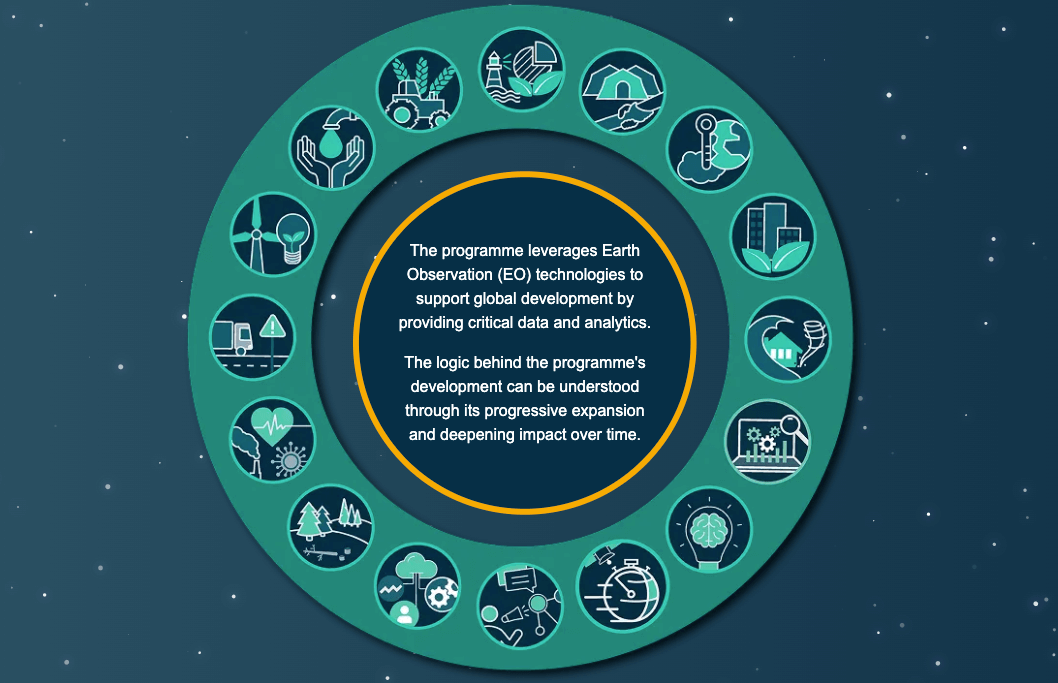
This effort was supported by the ESA’s Global Development Assistance (GDA) programme which has as objective to enhance the impact of projects delivered by International Financial Institutions (IFIs) such as the EBRD by embedding EO into operational workflows across different sectors and along project lifecycles. By showcasing EO’s contribution to sustainable urban planning, the Sarajevo project serves as a model for scaling similar methodologies to other cities. Beyond this assessment, the project serves as a first successful showcase of how using the power of space data can facilitate impactful investments and support broader uptake of EO-based solutions across different functions and sectors of the EBRD’s operations.
EO Application
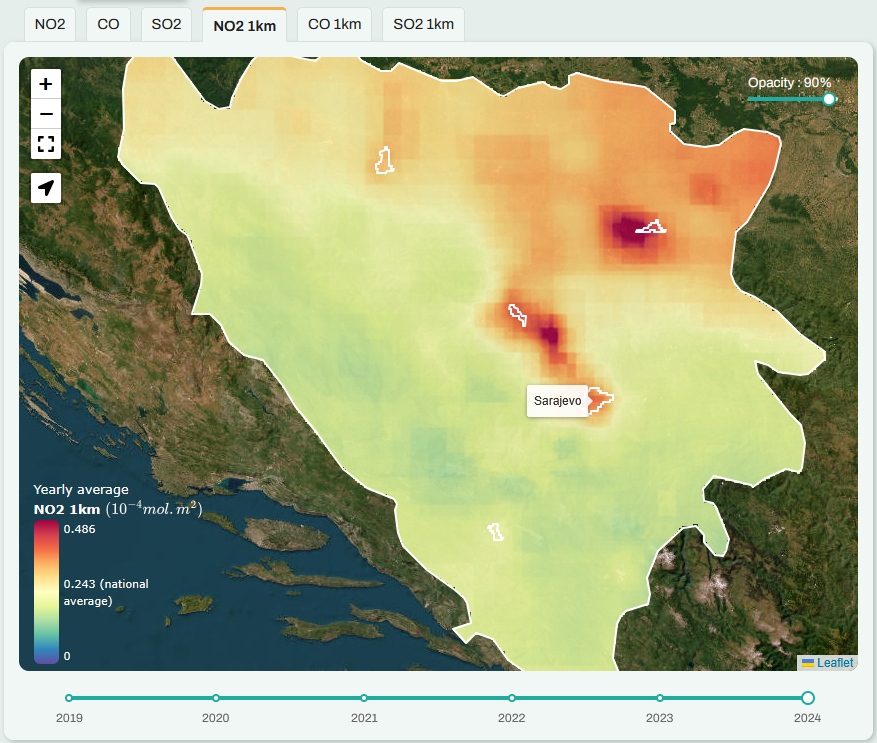
To address gaps in the local air quality monitoring, the project implemented EO-based solutions using data from the Copernicus Atmosphere Monitoring Service (CAMS) and Sentinel-5P. This high-resolution data was processed using machine learning techniques to downscale satellite data to 1-km resolution. Weather-normalised models were developed to isolate anthropogenic influences from meteorological variations. An interactive online end-user dashboard provided real-time and historical insights to stakeholders.
Over a 3-month period, this ESA GDA project delivered three key services: air quality analysis for six key air pollutants based on CAMS data (Service 1) and Sentinel-5p data (Service 2), and cross-correlation with traffic data (Service 3).
Air quality analysis based on CAMS
From 2019 to 2024, daily air quality data from the CAMS were acquired and downscaled to a 1-km resolution over Sarajevo. This was achieved using an advanced machine learning framework that integrated diverse datasets, including meteorological data, emissions inventories, land cover, and population density. Models such as XGBoost were trained and validated against ground-based sensor data to refine pollutant estimates for NO₂ and PM₂.₅. The approach significantly improved spatial accuracy, enabling precise urban-scale monitoring and supporting informed environmental policymaking.

Air quality analysis based on Sentinel-5p
For the analysis of air quality based on Sentinel-5p data, weather-normalised pollutant models were developed using the LightGBM machine learning framework. These models accounted for key climate variables (e.g., temperature, wind, boundary layer height) and spatial factors such as population density, elevation, and CAMS forecast data. Separate models were trained for NO₂, CO, and SO₂, using a robust preprocessing pipeline and hyperparameter tuning. This approach enabled the isolation of human-induced pollution changes from meteorological influences, improving the accuracy of before–after comparisons and supporting the assessment of urban interventions in Sarajevo.
Correlation between air quality and traffic data
To explore the correlation between air quality and public transport, pollutant levels were analysed alongside public transport infrastructure upgrades in Sarajevo. Data from CAMS and Sentinel-5p were cross-analysed, revealing seasonal patterns and spatial trends. Visualisations and model validation using in-situ measurements confirmed the reliability of the results, though definitive conclusions were limited by short observation periods and external influencing factors such as meteorological conditions.
Results and Impact
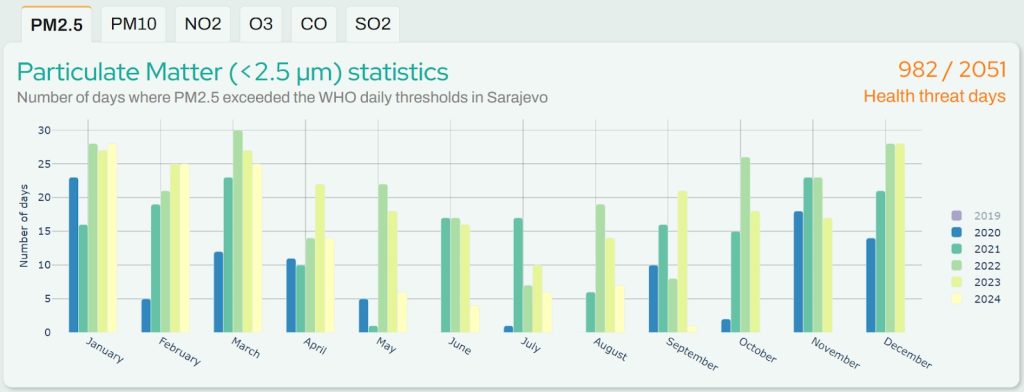
The EO-enabled analysis revealed significant seasonal and spatial variability in air pollutants concentrations, with winter values over Sarajevo more than twice the national average. An alignment between CAMS and Sentinel-5P datasets was observed for trend analyses, providing valuable insights into the region’s air quality dynamics. While initial findings suggest a partial correlation between public transport infrastructure upgrades and air quality levels, the evidence remains inconclusive due to short observation windows and complex influencing factors such as weather conditions and limited data availability for validation. Nonetheless, the methodology demonstrated EO’s potential for scalable, replicable urban environmental assessments and policy support.
Importantly, this project provided a proof of concept for EO data for air quality monitoring in urban areas, supporting the decision to expand these types of dashboards for other cities, and in turn decreasing the data collection burden of both municipal authorities and EBRD operational teams.
Stakeholder Engagement
The project was co-developed with the EBRD and local stakeholders, incorporating in-situ data and feedback loops to validate EO outputs. Ground truth measurements from OpenAQ and local sources enhanced model accuracy and credibility. Regular interactions ensured alignment with local infrastructure developments and policy frameworks.
Uptake of EO in IFI Processes
The project exemplifies how EO technologies can directly inform IFIs operations. In this case, the EBRD leveraged EO insights to support environmental assessments linked to urban infrastructure investments. The EO-derived data enabled validation against WHO guidelines and helped substantiate local air quality fluctuations, supporting the assessment of the impact of public transport interventions, and promoting evidence-based decisions in EBRD’s activities.
Benefits of EO for IFIs
EO provided timely, cost-effective, and high-resolution data across Sarajevo and its surrounding regions, particularly valuable where in-situ monitoring is limited. The integration of CAMS and Sentinel-5P datasets offered comprehensive pollution assessments.
Machine learning techniques enhanced spatial resolution, and weather-normalisation isolated anthropogenic effects, offering robust tools for environmental and infrastructure planning. This project highlights several key benefits of EO for IFIs: filling data gaps in under-monitored regions, providing consistent, granular time-series observations, and enabling standardized, globally comparable data collection methodologies.
Conclusion / Next Steps
The project sets a foundation for extended EO integration into urban planning and climate resilience strategies, while also demonstrating the power of EO in any type of EBRD operation. Follow-up projects could include longer-term monitoring, expanded ground data networks, and tailored dashboards for other EBRD Green Cities. Continued collaboration between ESA, EBRD, and local entities will be essential to amplify the impact and scalability of EO-based environmental management solutions.
“This collaboration with ESA demonstrates the transformative potential of Earth Observation data and analysis for robust impact assessments across EBRD operations. By combining our institutional expertise with ESA’s advanced EO technologies, we’ve taken important steps toward deepening our understanding of environmental outcomes in Sarajevo and beyond. While the findings are preliminary, this work helps pave the way for more systematic data collection and integration, ultimately supporting better risk management, more informed investments, and stronger capacity in our countries of operations—well beyond urban infrastructure, across sectors such as energy, water, and agriculture”
Lorenzo Ciari, Director, Impact, EBRD