









Somalia is highly vulnerable to climate shocks, with frequent droughts and floods disrupting agriculture and livestock-based livelihoods. In this context, the UN’s International Fund for Agricultural Development (IFAD) is exploring how Earth Observation (EO) can strengthen water resources planning in Somalia, especially where ground data are limited and access is difficult.
Increased variability in weather patterns has contributed to crop failures and loss of livestock, as well as population displacement and the establishment of large IDP camps. This has exacerbated food and water insecurity and increased vulnerability among rural communities. Most of the population depends on groundwater for domestic water supply, livestock and small-scale irrigation, except for communities along the Juba and Shabelle Rivers that can draw on surface water. At the same time, developing new groundwater resources remains challenging, due technical difficulties and water quality constraints.
Through ESA’s Global Development Assistance (GDA) Water Resources activity, EO-based groundwater monitoring products were delivered to support IFAD’s programme in Somalia, which currently covers the Hirshabelle, Galmudug, Southwest and Jubbaland states. Implemented by GMV, the work aimed to provide evidence that can inform water resources management and support climate-resilient livelihoods.
What EO products were delivered to IFAD
GDA delivered:
- a historical groundwater analysis (2003–2024) (monthly, seasonal, annual and multiannual) at national and federal state levels
- a groundwater drought assessment, designed to support the interpretation of groundwater stress patterns over time.
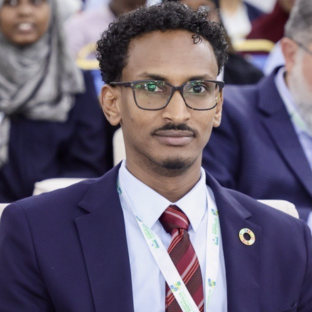
According to the IFAD Country Presence Officer, there is high potential for uptake of the EO products delivered, reflecting their potential for integration within IFAD’s programme activities. This relates to water-related actions within the programme, for example to inform water resources management in regions showing groundwater drought. While specific applications of the results are still being defined, the delivered products are also relevant to other partners operating water information systems, such as FAO-SWALIM. Specifically, these products provide essential information to support sustainable groundwater resources management, inform drought preparedness strategies and guide decision-making at national and regional levels.
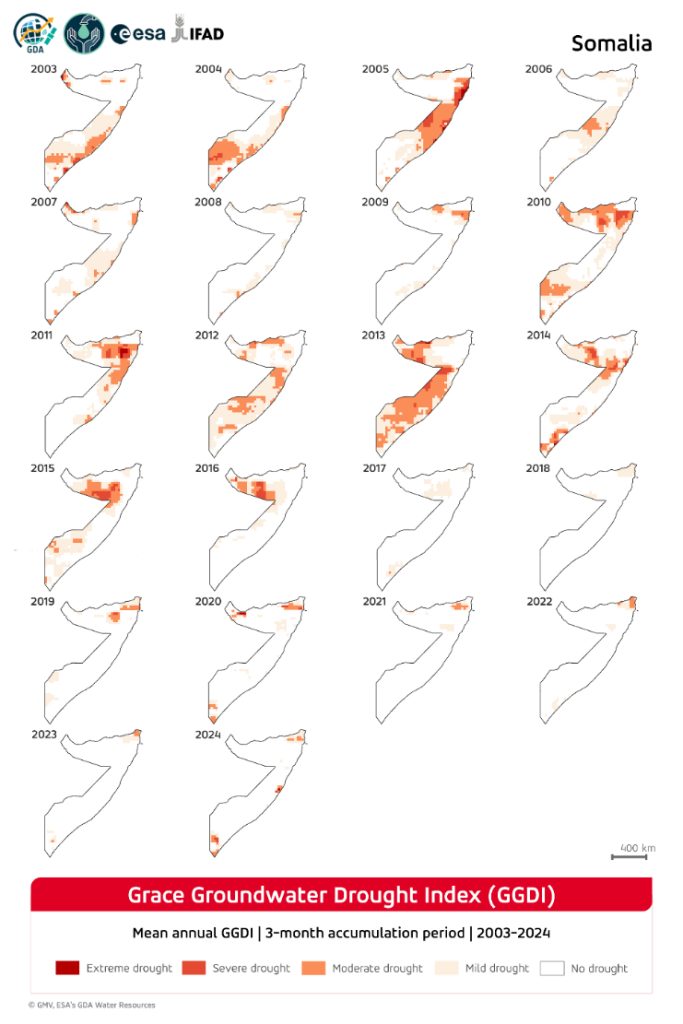
Figure 1 shows the annual evolution of the GRACE groundwater drought index (GGDI) across Somalia from 2003 to 2024. The GGDI represents deviations in groundwater storage relative to normal conditions, with more negative values indicating drier-than-normal conditions once they fall below a defined threshold. These values can be linked to drought severity categories as represented in Figure 1 Although groundwater drought conditions are present across all years, the most extensive and severe conditions occurred during 2003–2005 and 2010–2013. From 2017 onwards, the extent and severity of hydrogeologicaldrought decreased significantly across the country, with isolated areas mainly in the north, suggesting a general transition toward wetter conditions in recent years.
Conclusion
With a 2003–2024 groundwater analysis and a groundwater drought assessment now delivered, IFAD teams have a ready evidence base to flag where groundwater stress is persistent or worsening and to support water-related planning in the Hirshabelle, Galmudug, Southwest and Jubbaland states. As IFAD defines specific use cases, these EO products also provide a shared reference for national counterparts and partners operating water information systems, including FAO-SWALIM, whose geoportal dashboard now hosts the groundwater monitoring products developed under ESA GDA water activity.