










ESA’s GDA Public Health thematic activity has just released its first set of case studies, providing a compelling overview of the ways in which satellite data is enhancing health outcomes on the ESA GDA Public Health website.
Ranging from the tracking of heat stress to the critical backing of early warning systems for disease outbreaks, the selected case studies express the important capability of Earth Observation (EO) as an instrument for public health planning.
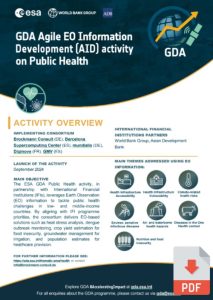
A newly published brochure featured on the ESA’s GDA Public Health website brings into perspective EO-based services that are being offered by the consortium to meet the requirements of International Financial Institutions (IFIs) and partner nations as they work to strengthen their health systems. There is also a downloadable flyer that provides an overview of the current ESA GDA Public Health thematic activity.
Public health is not an isolated phenomenon but one that is strongly linked to the condition of the environment. Climate change, land use change, and urbanisation have profound effects on disease transmission, healthcare access, and the generation of vulnerabilities. EO provides policymakers timely, precise, and comprehensive information that can address key gaps in conventional monitoring systems.
Every case study has been developed carefully in partnership with the IFI teams at the World Bank and the Asian Development Bank to be certain that the EO services are targeting actual demands.
With these first case studies now starting, ESA’s GDA Public Health is building a growing portfolio that demonstrates how satellite-based information can make a tangible difference in how we prepare for and react to current and future health challenges.