










Yemen is currently experiencing one of the world’s most severe water crises, driven by a combination of chronic water scarcity, excessive groundwater depletion, and the protracted armed conflict. Groundwater represents the backbone of the country’s water supply, sustaining drinking water, sanitation systems, and agricultural livelihoods, yet it is being over extracted. Since the escalation of the conflict in 2015, widespread damage to water and sewage infrastructure, together with pollution resulting from military operations, has severely compromised water quality across large parts of the country. As a result, many water sources have become unsafe for human consumption, triggering recurrent outbreaks of waterborne diseases. Among the most devastating was the cholera epidemic that affected more than one million people between 2017 and 2019, highlighting the direct link between water insecurity and public health emergencies.
In response to these growing challenges, the GDA activity on Public Health has partnered with the World Bank to monitor and quantify groundwater resources across Yemen using Earth Observation. By providing consistent, large-scale insights into groundwater dynamics in a context where in situ measurements are scarce or inaccessible, this collaboration aims to support evidence-based decision-making and contribute to more sustainable water management in one of the world’s most fragile humanitarian settings.
Monitoring and quantifying groundwater
To better understand how Yemen’s groundwater is changing, the analysis was carried out at two different scales. At the national level, satellite-based maps were produced to track groundwater conditions across the entire country. In parallel, a more detailed time- series analysis focused on the Aden–Tuban Basin, a key socio-economical hub.
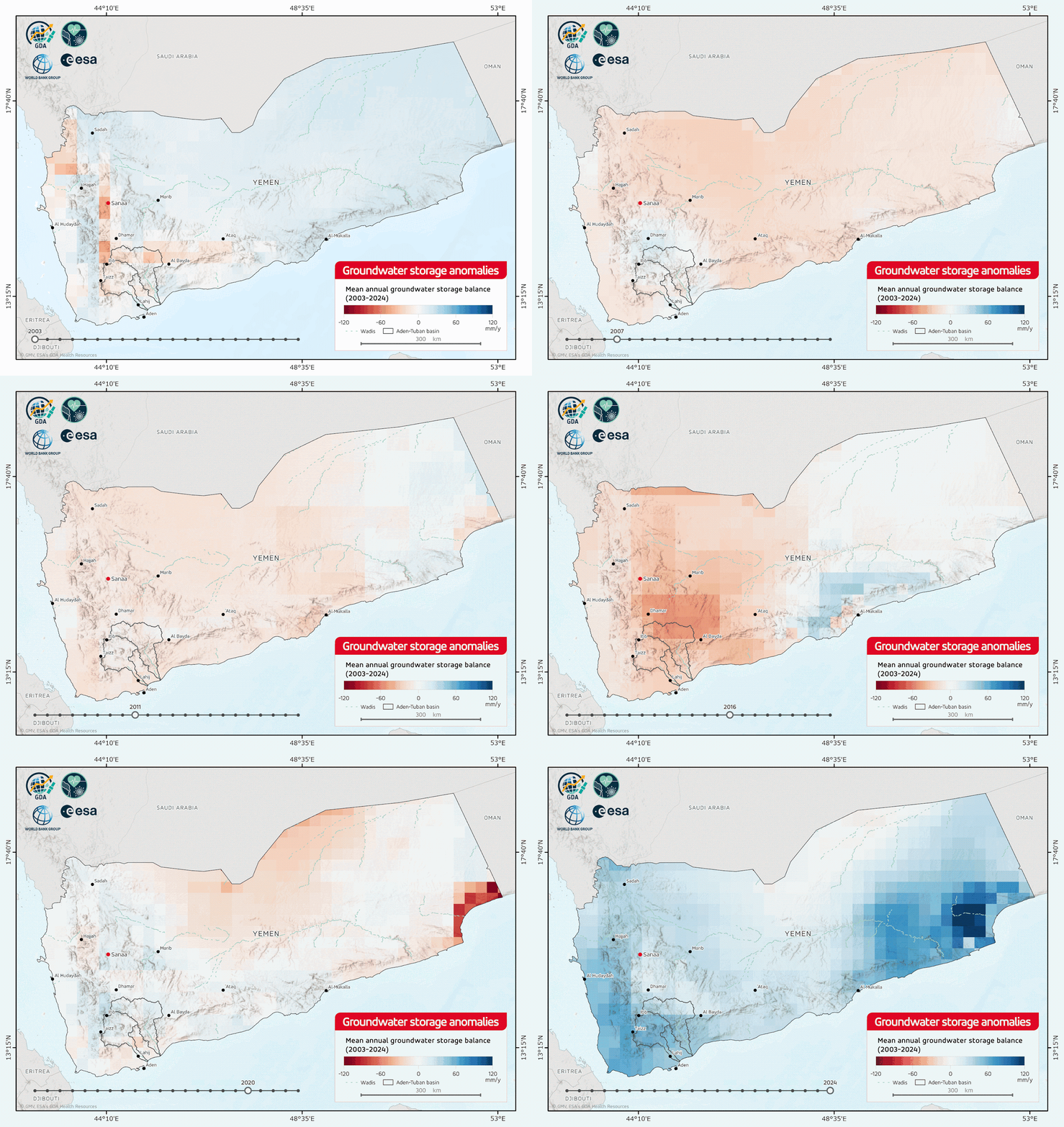
Results show groundwater levels are steadily declining at national level, confirming that Yemen is using its underground water reserves faster than they are being replenished. In the Aden–Tuban Basin, however, heavy cyclones during the past few years have temporarily refilled the aquifers, offering short-term relief.
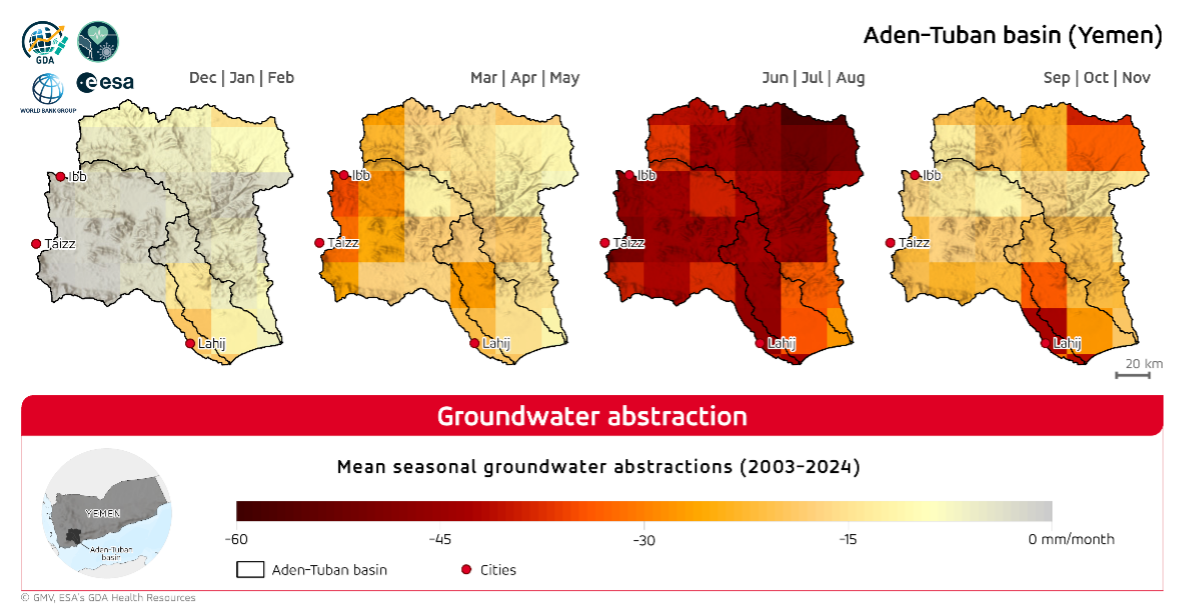
This recovery, however, masks a deeper problem. When groundwater abstractions were estimated in the basin, the analysis revealed that water extraction continues to exceed the amount naturally replenished by rainfall.
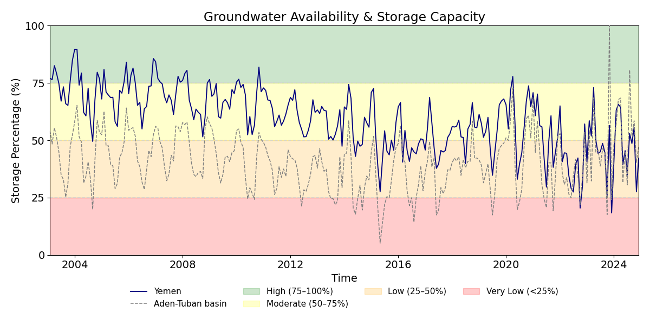
To make these findings accessible to non-experts, complex groundwater storage data were translated into groundwater availability (%), which uses a simple traffic-light color code to indicate water status, providing an intuitive tool to support decision-making and highlight areas under stress. The study also assessed groundwater drought conditions and recharge patterns, helping identify where water shortages are likely to intensify.
These findings deliver a clear message: without sustained monitoring and integrated water management, Yemen’s vital groundwater resources remain at serious risk, threatening water security, public health, and livelihood.
Local stakeholders endorsed the results. The Yemeni Geological Survey noted that the findings closely match their own assessments and emphasized their value for the country, particularly to fill data gaps, given that in situ data have been severely limited since 2010 due to the armed conflict.
The findings from this collaboration carry implications that extend well beyond Yemen. Across the FCV landscape, water crises are frequently compounded by the collapse of monitoring systems, leaving little data to guide effective interventions. The Yemen case demonstrates that Earth Observation can step in where ground-based data collection has broken down, delivering scientifically robust, policy-relevant insights at both national and basin scales. The ambition is to establish a replicable, operationally viable framework that other country teams and partner organizations can deploy in similarly constrained settings, making evidence-based water management possible even in the world’s most fragile environments.
Ultimately, this work illustrates what Earth Observation can realistically offer in settings like Yemen: not a perfect substitute for in-situ monitoring, but a valuable and practical means of filling critical data gaps where ground-based systems have collapsed or never fully existed. For Yemen and other fragile states facing similar constraints, continued investment in combining EO approaches with efforts to gradually rebuild local monitoring capacity offers a pragmatic path toward more informed and sustainable water management.