











Public Health has a number of interactive stories on the GDA Impact Sphere platform. Explore the case study about how EO contributes to controlling dengue outbreaks in Timor Leste.
Climate change is altering patterns of disease and placing growing pressure on health systems across Asia and the Pacific. In response, the Asian Development Bank (ADB) launched its Climate and Health Initiative in 2023 at COP28 to help its developing member countries (DMCs) build health systems that are more resilient to climate-related risks and better equipped to translate climate information into public health action. The initiative combines knowledge generation, innovation, partnerships, capacity development, and financing to support practical and scalable climate-health solutions.
Climate-informed surveillance and early warning systems are an important part of this agenda. By combining information on weather, environmental conditions, disease occurrence, and population vulnerability, these systems can help governments shift from reacting after a health emergency has escalated to anticipating risks and acting earlier. From ADB’s perspective, an early warning system is not just a forecasting tool; it provides decision-makers with sufficient lead time, identifies where risks are likely to be greatest, and links forecasts to clearly defined and targeted actions.
To shift from crisis response to proactive prevention, ADB partnered with the Barcelona Supercomputing Center (BSC) to develop the region’s first prototype dengue Early Warning System, with support from the European Space Agency’s (ESA) Global Development Assistance (GDA) Public Health programme. As part of this effort, a statistical model was co-developed using multi-year satellite-derived climate data, high-resolution demographic and census information, and local knowledge for Pakistan.
Every year, as Pakistan’s monsoon rains fade and October approaches, a predictable crisis unfolds: dengue fever surges through cities like Lahore, Karachi, and Rawalpindi, filling hospital wards and claiming lives. The disease remains a major public health challenge in Pakistan, particularly in Punjab and Sindh, which together are home to nearly 200 million people. As a climate-sensitive disease, dengue transmission is strongly influenced by environmental conditions. Temperature affects mosquito development, survival, and biting behavior, while rainfall creates the standing-water habitats required for mosquito breeding. Understanding these climate-health relationships is therefore critical for anticipating outbreaks and reducing their impact. Validation against historical outbreak records demonstrated that the prototype model could predict major epidemic waves several months in advance with a high degree of accuracy.
The “September bridge”: a strategic window for action
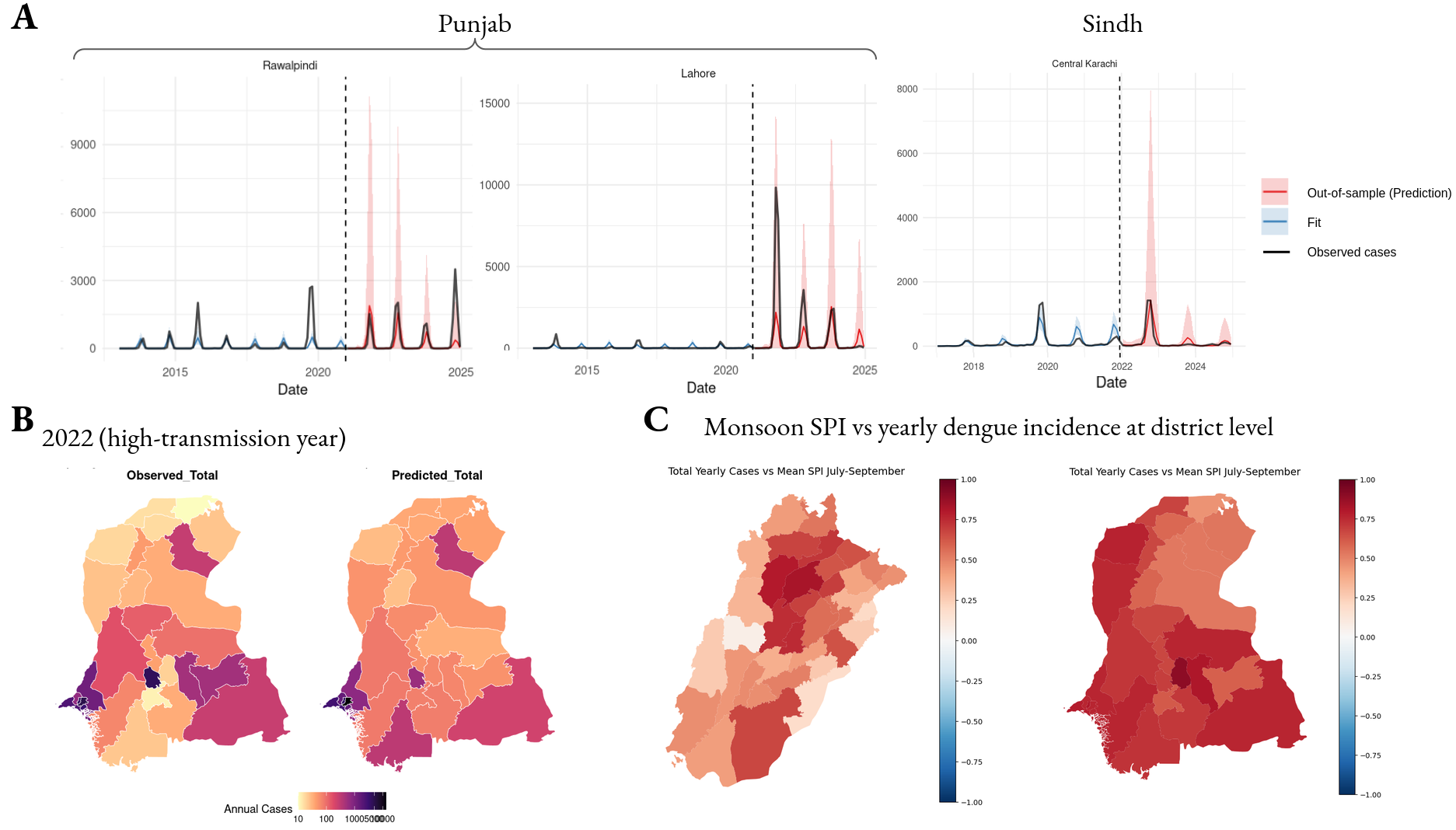
Dengue transmission in the region is highly seasonal, consistently peaking in the post-monsoon period. However, the magnitude of epidemics varies substantially from year to year, with strong interannual fluctuations that have remained poorly understood to date. By integrating weather and epidemiological data, we identified a key driver of this variability: a robust ecological relationship between the summer monsoon and the magnitude of annual dengue epidemics (Fig. 1). More than 50% of the variability in dengue peak magnitude can be attributed to monsoon intensity, with explanatory power reaching as high as 90% in some areas (Fig. 2C for regional results).
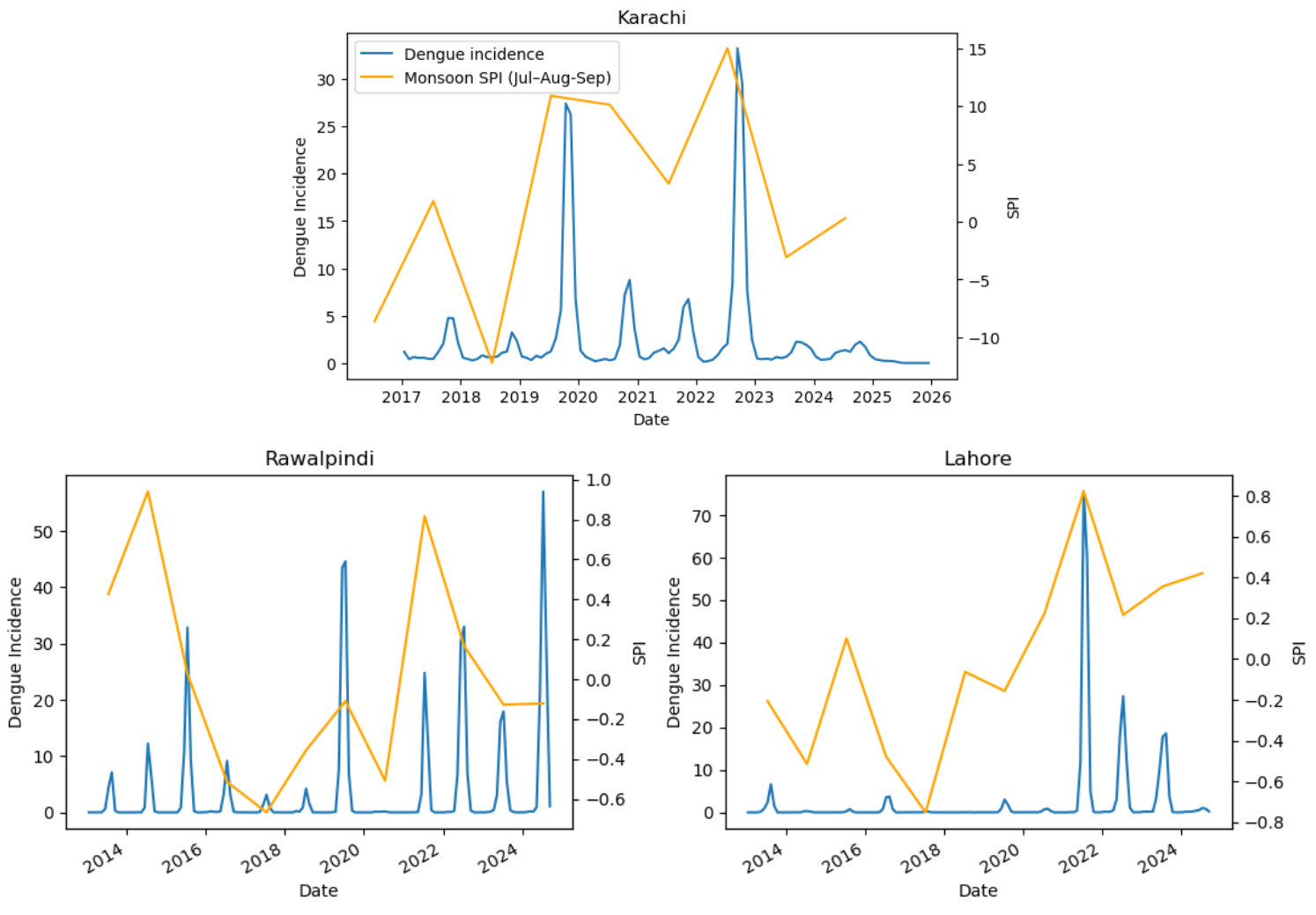
A more detailed analysis revealed that different phases of the monsoon play distinct roles in shaping epidemic dynamics. While July rainfall, the peak of the monsoon, establishes the initial mosquito breeding grounds, September rainfall, marking the monsoon’s end, acts as a critical ecological bridge toward the annual dengue peak in October. When September experiences above-average rainfall, it prevents widespread breeding sites from drying out prematurely, sustaining high mosquito densities as the region transitions into October, the month of peak transmission. September rain can be thought of as a lifeline for mosquito populations; keeping their breeding pools full just long enough to fuel the October surge.
This timing is particularly important because October’s temperature conditions are highly favorable for viral replication. Although total monsoon rainfall influences the overall dengue burden, September rainfall emerged as the strongest immediate predictor of outbreak magnitude.
This mechanistic insight provides policymakers with a clear and actionable window for intervention. Vector control measures implemented during the intense rains of July and August can often be washed away or diluted by monsoon downpours. In contrast, targeted interventions deployed in September can effectively break this transmission bridge by eliminating aquatic mosquito populations before they emerge and contribute to the October epidemic peak.
How does it work?
To evaluate the system’s performance under realistic operational conditions, the team conducted rigorous “blind” testing. The model was trained on a multi-year historical baseline, and then a full year of actual health data was completely hidden. The system was tasked with predicting the unknown outcome using only climate records and historical baseline rules, mirroring an authentic live scenario (Fig. 2)
The model consistently reproduced the timing and magnitude of major outbreaks, demonstrating strong predictive skill under realistic forecasting conditions and providing confidence in its operational potential.
Building trust, engagement and long-term usability
A core focus of ESA’s GDA thematic activity is ensuring that advanced spatial workflows can be easily understood, integrated, and scaled by national authorities who may not be experts in satellite analytics or statistical modeling. Built entirely upon transparent, open-source data structures, the methodology is highly cost-effective and fully replicable across other climate-vulnerable nations in South Asia and beyond.
The prototype is technically ready for live deployment, but it currently faces a key operational hurdle: it cannot yet access automated, real-time pipelines for digital health data within Pakistan, limiting the system to a demonstration phase. Moving forward, the crucial next phase involves deep engagement and trust-building with all relevant Pakistani authorities to transition this valuable prototype into a permanent cornerstone of the country’s routine planning.
Strategic policy roadmap
For leaders and policymakers, the roadmap to building a climate-resilient health system is clear:
- Automate Health Data: Investing in digital, automated pipelines to report local health data in real time will allow this early warning system to run in a fully operational, near-real-time mode.
- Prioritize High-Risk Urban Areas: Rather than spreading resources thin, preventative funding and mosquito control should be concentrated in major urban centres (Lahore, Karachi, and Rawalpindi), where population density drives the highest risk.
- Prioritize September Interventions: Public health calendars should prioritize September as the key intervention window, using the system’s climate insights to suppress the mosquito population before the October surge can materialize.
Key takeaways
- Co-Developed Protection: Under ESA’s GDA Public Health thematic activity, the Asian Development Bank and BSC co-developed an EO-driven dengue early warning system to help reduce the dengue burden in Punjab and Sindh.
- The September Window: The case-study demonstrated that September rainfall acts as a biological “bridge” for vector survival; targeting vector control during this specific month yields the highest preventive impact.
- Sustainable and Replicable: Built on global open-source datasets, the workflow offers an affordable, highly scalable methodology that can be adapted by other climate-vulnerable health systems worldwide.