













Rising temperatures and more frequent extreme heat events pose an increasing threat to public health in Pakistan. Ranked among the world’s most climate-vulnerable countries, Pakistan regularly faces heat waves that endanger the health and livelihoods of millions, especially the elderly, children and people with chronic illnesses.
To support better planning and adaptation to this current and future challenges in the public health sector in Pakistan, ESA’s Global Development Assistance (GDA) Public Health thematic activity is working with the Asian Development Bank (ADB) to develop a Climate-Health Data and Earth Observation (EO) Services Platform including analysis and policy-making tools for heat stress assessment. This scalable web-based platform brings together satellite-derived climate information on heat and population data to visualise heat stress and risk patterns and to identify vulnerable areas for interventions.To ensure the platform and EO products meet real user needs, the development has been carried out in close collaboration with the ADB’s Health team. The first outcomes of the EO products developed under GDA Public Health for Pakistan were presented at the INSPIRE Health Forum in Manila in July 2025, where ADB supported the consortium’s participation and facilitated different sessions and talks. Since then, ADB has been organising online workshops connecting the consortium with national stakeholders such as public health authorities and ministries. Their feedback informs the design of the EO products and helps align the work with future operational needs.
Supporting adaptation and preparedness to heat stress in Pakistan
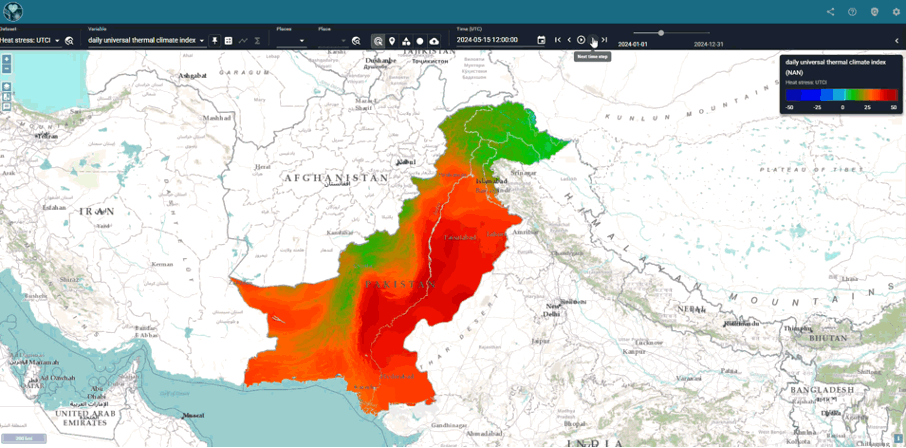
The collaboration builds on ADB’s increasing engagement on heat and climate–health challenges in Asia and the Pacific. The bank is working to expand the understanding of extreme heat risks through initiatives such as developing tools for country-wide heat stress risk mapping, supporting city-level capacity building, and promoting data standardisation and climate–health integration to enable predictive health planning. These efforts provide a strong framework for the ongoing GDA Public Health activity to potentially support future ADB knowledge platforms and decision-making processes as the case study progresses.By providing reliable, up-to-date heat stress information, these EO products support a wide range of applications. Public authorities can use the data to inform heat action plans, guide urban adaptation strategies, and strengthen health system preparedness during extreme heat events. High-resolution, long-term UTCI datasets (Universal Thermal Climate Index) also offer valuable input for research, planning and policy development in climate-sensitive sectors such as public health.
This story highlights the latest developments of the collaboration. The first of two-development cycles in ESA’s GDA AID Public Health has delivered baseline Earth Observation products for heat stress analysis, including daily Universal Thermal Climate Index data and climate variable datasets for Pakistan. The team is now refining the platform and data services based on feedback from the Asian Development Bank (ADB) and national stakeholders. By improving the underlying data basis and delivering high-resolution, analysis-ready information, ESA GDA’s Public Health EO services are helping Pakistan to build a more robust and sustainable climate–health monitoring system.
A comprehensive heat stress indicator for public health preparedness
The Universal Thermal Climate Index is calculated from hourly ERA5-Land reanalysis data provided by the Copernicus Climate Change Service. Key variables include air temperature, wind speed, humidity, and the calculated intermediate product mean radiant temperature. These are combined using a predefined polynomial regression model, which approximates the complex exchange of heat between the human body and the surrounding environment. The result is expressed in degrees Celsius and can be further classified into heat stress categories ranging from extreme cold to extreme heat stress. Temporal aggregations of these daily values help identify hotspot areas with prolonged heat exposure (Błażejczyk et al. 2013).

Direct impacts of increasing heat stress include dehydration, heatstroke, and heightened mortality from cardiorespiratory and other illnesses. Indirect impacts encompass the spread of infectious diseases and increased pulmonary stress due to elevated air pollution during heatwaves. Among infectious diseases, waterborne and foodborne illnesses, as well as vector-borne diseases, are of particular concern. These impacts underscore the growing importance of integrating heat stress monitoring into public health systems to enhance preparedness (Romanello et al. 2024).
Building capacity for long-term use
A key focus of the activity is to ensure that EO-derived heat stress products are usable, replicable, and sustainable in the long term. Building on lessons from earlier ESA GDA activities, the activity supports interpreting, validating and integrating EO heat stress data into ADB’s planning and response workflows. Transparent methods and open-source tools are at the core of this approach, enabling the ADB members and national experts to adapt them to local contexts, and build on the service over time.
The work in Pakistan demonstrates the high potential of EO to complement national climate and health monitoring efforts, offering timely, spatially detailed information to support public health preparedness and urban adaptation planning. By providing cost-effective and regularly updated datasets, EO can fill critical data gaps and strengthen national capacities to anticipate and respond to extreme heat.
Refining products for implementation and forward look
In the coming months, the consortium will refine the heat stress products including heat stress and population at-risk data and finalise recommendations for their operational use. By embedding these EO capabilities, Pakistan will be able to enhance heat risk monitoring, inform targeted interventions, and strengthen its overall public health initiatives