













On 12 November 2025, the ESA GDA Health activity contributed to the Asian Development Bank (ADB) Climate and Health Initiative webinar ‘Beating the Heat: Healthy Communities of the Future’. The session brought together ADB specialists and invited experts working on climate, health and heat resilience across Asia and the Pacific. Representing ESA’s GDA Public Health activity, Lennart Meine (Mundialis) presented the latest developments of the Climate-Health Data and EO Services Platform being co-developed with ADB for Pakistan.
Meine’s presentation introduced the EO products currently under development, including daily Universal Thermal Climate Index (UTCI) datasets and climate variable rasters such as temperature, precipitation, relative humidity and wind speed. These datasets form the basis of the platform’s heat-stress analysis and were shown through visual examples covering Pakistan. The EO layers provide spatially detailed insight into the climatic conditions that contribute to heat exposure and climate-sensitive health risks.
During the session, ADB highlighted how extreme heat is becoming a critical issue across Asia and the Pacific. The discussions emphasised that increasing temperatures and prolonged exposure are affecting large parts of the population, and that decision-makers require more reliable, science-based information to support adaptation. ADB noted the importance of strengthening risk assessment tools, improving forecasting capabilities, investing in the resilience of public services, ensuring measures to protect workers and fostering knowledge sharing and collaboration. These priorities reflect the broader direction of ADB’s Climate and Health Initiative and frame the context in which the GDA Public Health collaboration is progressing.
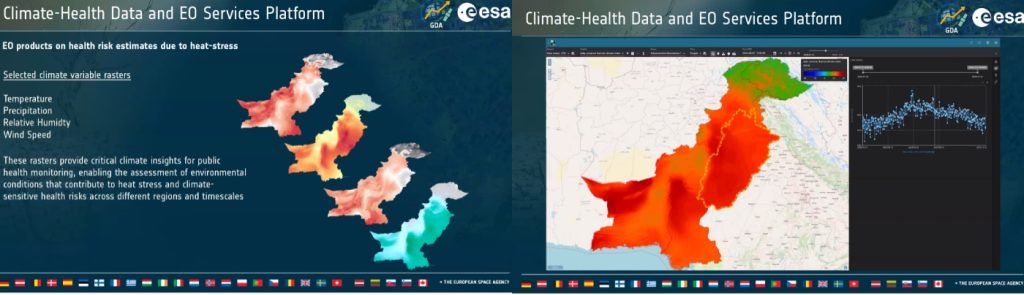
The Pakistan case study presented by the GDA Public Health activity directly supports GDA’s mandate to increase EO uptake within International Financial Institutions. The work is being carried out through a co-design approach with ADB’s Health team and national stakeholders, ensuring that EO products respond to operational needs and can feed into future analytical platforms and decision-making processes.

In the next development cycle, the GDA Health activity will continue refining the heat-stress and population-at-risk layers, integrating user feedback and preparing recommendations for their operational use. The activity aims to strengthen heat-risk monitoring in Pakistan while contributing to ADB’s broader regional efforts on climate-health resilience.